


6 Major Psychological Frameworks
Throughout my education, 6 major psychological frameworks were used to explain perspectives in a variety of contexts. The following frameworks are approximately ordered from least recent to most recent. No single framework can explain human behavior the best. It is best to use multiple applicable frameworks to understand others. Seeing any area of concern from multiple perspectives allows us to contextualize information, reduce bias, and provide well-rounded support.
I hope that gaining a basic understanding of how psychological and developmental theorists view the world will evoke curiosity about the nature of the human experience.
1.
Psychodynamic Theory

Topography of Mind: Freud's Mental Iceberg. Digital Image. 2011. http://r3nonmonday.blogspot.com/2011/11/topography-of-mind-freuds-iceberg.html
The Psychodynamic Theory is known to be the first form of Western Psychology. It is also known as the psychoanalytic theory. It was pioneered by Sigmund Freud in the 1890s. In this theory, it is the unconscious mind that is mostly responsible for differences in behavior. The psychodynamic theory emphasizes early childhood experiences, and attempts to make the unconscious conscious.
Freud asserts many thought-provoking arguments about the nature of the human mind that are still very much in consideration today. Out of all the models, the idea of the unconscious mind is best represented in the psychodynamic model. He had many ideas about the human psyche, but I will delve into just a few of his theories.
Freud's Topographic Model
Freud's Topographic Model, as pictured on the left, is comprised of three parts: the conscious (thoughts we are aware of), the pre/subconscious (a large body of retrievable information), and the unconscious (the vast body of thoughts we are unaware of). Freud believed that it is the large, unconscious realm of our minds that predominantly dictates our behaviors.
Id, Ego, and Superego
The Topographic Model also represents the id, ego, and superego. According to Freud, the id, or the unconscious, emerges at birth. It is based on life, pleasure, death/instinctual aggression, and wish fulfillment principles. If the wishes cannot be fulfilled, desires are imaged by the id in the form of dreams or other unconscious notions. The ego, contains all three elements: unconscious, pre/subconscious, and conscious. It emerges during late infancy and is based on reality principles –– it tries to satisfy id wishes in a realistic way. The ego moves between the unconscious, and pre/subconscious realms, in order to reduce tension. The superego emerges around age 5. It also contains all three elements, is based on societal values, standards, and ego ideals. In this way, it represents moral development and our conscience. It provides ideals that the ego must use to determine morals and worth. It restrains us from carrying out unacceptable behaviors, but it can also restrain us too much.
Defense Mechanisms
According to Freud, defense mechanisms are created by the ego as a means for protection. Neurotic anxiety is the anxiety that accumulates when unacceptable, unconscious thoughts are moving into our consciousness. There are multitude of different defense mechanisms. Here are some:
Repression: This is the cornerstone of psychoanalysis. It is an unconscious effort of the ego to push threatening material out of consciousness. Repression drains our ability to function.
Suppression: The other side of repression. This is a conscious effort of the ego to push threatening material out of consciousness. In other words, you have at least some awareness that you are trying not to think about something. Like repression, it is unproductive in the sense that it drains our ability to function at full capacity.
Sublimation: This is considered to be on the only defense mechanism that improves productivity. In sublimation, the ego channels threatening unconscious impulses into socially acceptable actions. For example, perhaps you have unconscious urges for physical aggression or pain. The ego may channel this impulse into productive athletic endeavors.
Displacement: Similar to sublimation except the impulses do not lead to social rewards. Unconscious impulses stemming from a particular situation are displaced into other situations that may or may not be related. For example, anger and aggressive impulses due to work stress may be displaced into the family home.
Intellectualization: This is the process of removing emotional content before allowing it come into consciousness.
Another famous psychodynamic theorist is Erik Erickson. He revised Freud's controversial psychosexual model into a social development model. Erikson's social development model provides valuable insights to human development. In his developmental model, different approximate age ranges have distinct psychosocial crises, or challenges to endure. This theory has impacted how educators, caregivers, and psychologists support human development. On the other hand, researchers often discuss how generalizable the model is to other cultures.

Freud has provided invaluable theories and means of understanding the human psyche in countless ways. In the above theories, I attempted to showcase some of his most useful and relevant work. However, Freud is also one of the most controversial people in the psychological community due to his radical ideas, and questionable methods of gathering data. To learn more about why Freud is so influential, click here. To learn more about why he is so controversial, click here.
Erickson's Stages of Psychosocial Development | Psychology. Digital Image. Psychology Discussion. http://www.psychologydiscussion.net/developmental-psychology/eriksons-stages-of-psychological-development-psychology/13403
Strengths & Weaknesses:
As the first western theory in psychology, the psychodynamic theory has provided an impressive amount to society and the psychological community. The idea of the unconscious mind is an interesting one because it is both impossible to argue against, and impossible to directly observe thus far. Tests that help therapists get an idea of their client's unconscious world include the Rorschach Ink Blot Test, dream analysis, and drawing tests. These tests, when used in combination with other standardized tests of behavior, provide unique information that no other tests can provide. However, diagnosing someone solely on the basis of psychodynamic tests is strongly advised against in the psychological community. Psychodynamic tests heavy rely on interpretation and assumptions about behaviors. The free-flowing format of most psychodynamic tests makes them impossible to standardize. This lack of standardization makes interpreter bias a pervasive convoluting variable.
2
Biological Theory
The Biological Theory observes behavior through the lens of biology. By studying brain chemistry, trait heritability, and genetic dispositions, biological theorists are able to explain differences among people from a biological perspective. It is important to conduct studies that look at biological factors (e.g., identical twin studies, finding genetic markers for behavioral patterns, gene sequencing, etc) so that we can better understand the complex interactions between genetics and our environment. Other examples of behavioral patterns that are informed by our biology include temperament, carrying certain genes that are related with emotional expression (e.g., depression, aggression anxiety, etc), and effects of environmental stress on biological functioning.
Within this theory, treatment is usually in the form of medication or drug therapy. For example, the role of antidepressants is to induce serotonin re-uptake because it has been found that serotonin levels are abnormally low in those diagnosed with major depressive disorder.

Simple Diagram of Brain. Digital Image. https://hi-static.z-dn.net/files/dff/e0ffe1c1e1681f7dcb27dc24e3b773d8.jpg
Strengths & Weaknesses
Like many of the models, its greatest strength is also its greatest weakness. Biological factors include a wide range of components that contribute to human behavior. Understanding biochemical relationships within the brain and body on individual and generational levels is very important for treatment and prevention. However, environmental factors such as habitual behavioral patterns, thinking styles, the quality of social relationships, and cultural practices are overlooked in the biological theory. Historically, biological mechanisms have been regarded as the most powerful moderator for human behavior. This has led to the minimization of other more psychologically and socially-based theories. Rather than pitting biology against environmental factors, such as the nature vs nurture argument, all theories must support each other to truly understand the scope of human behavior.
3.
Behavioral Theory
Also known as the social learning theory, behaviorists believe that people's behaviors and decision-making processes are a result of conditioning and expectation. This theory emerged in the late 1890s as a way to gain respect in the scientific community. Previous to the behavioral theory, psychology was belittled for its lack of empirical methods. Famous pioneers of behaviorism include Thorndike, Pavlov, Watson, Skinner, and Bandura.
There are two types of conditioning: classical and operant.

Classical Conditioning, part 3. Digital Image.
Classical Conditioning
Classical Conditioning refers to behavioral and emotional reflexes. Classical conditioning occurs when a situation is paired with our reflexive emotions. There are two types of classical conditioning: 1st Order and Higher Order.
1st Order conditioning always begins with reflexes. The most famous example is Watson and Little Albert. Little Albert was a toddler on a table in John Hopkins. He was introduced to a rat for the first time, and he was happy with it. After a short break, the rat was introduced to him again, which pleased him. However, this time, the moment he grabs the rat, Watson bangs metal together, causing Albert to reflexively cry. After only several tries, Albert developed a fear of the rat. When pairing the rat with a loud scary noise, Albert learned to be scared of the rat through the emotional reflex. To watch the experiment, click here. Nowadays, this experiment is deemed unethical and cannot be repeated.
A more common example of 1st Order conditioning is fear of spiders. In the same way that Albert developed fear for rats due to a loud noise, young children develop fear of spiders due to their caregivers expressing fear (which may also be a loud noise). Young children are primed to reflexively mirror their caregiver's emotions and behaviors as a mechanism to understand the world around them. When caregivers behave in fearful ways towards things such as spiders, children learn to fear them too. These fears are persistent, often lasting throughout an entire lifetime.
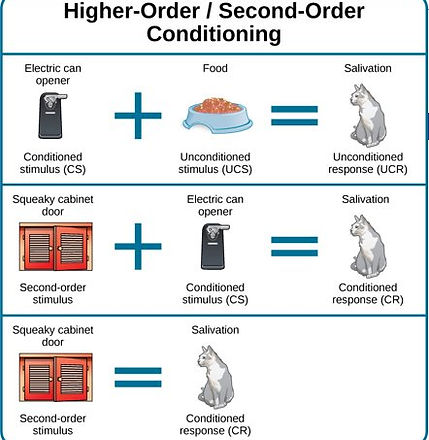
Higher Order Conditioning adds another level of complexity to conditioning. Rather than dealing with our reflexive emotions, it deals with the emotions we learned through first order conditioning. With enough conditioning, it engrains so deeply that it becomes reflexive. It explains how we can pair emotions or behaviors with any idea. For example, "bad" or undesirable things are paired with negative emotions such as fear, disgust, disappointment, hatred, etc. We learn to pair certain emotions and behaviors when with completely abstract ideas.
This can include any range of ideas including selfishness, being greedy, being disrespectful, being homeless, people of color, homosexual individuals, liberals, conservatives, and literally anything else. Regardless of whether or not it makes sense, if we are taught that something is bad, the negative emotional responses we have will imprint onto the idea. As infants, we do not reflexively garner negative feelings towards abstract concepts such as greediness, or specific political orientations; nor do infants instinctually have disgust or fear for people of color.
Real World Application of Classical Conditioning. Digital Image.
https://opened.cuny.edu/courseware/module/40/student/?task=2
According to behaviorists, this is what causes people to have reflexive negative (or positive) emotions to certain ideas, situations, and people. Learned behavior can become reflexive through conditioning. These are behaviors and expressions we learn from our major caregivers, mentors, peers, and communities. Higher order conditioning informs us that the behaviors we learn from those around us have a powerful effect on our emotional responses to the world.
Operant Conditioning
Simply put, operant conditioning is how we and other animals learn through reinforcement and punishment. Reinforcing a behavior means you are trying to increase a behavior. Punishing a behavior means you are trying to decrease a behavior. There are positive and negative types of both punishment and reinforcement. Positive means adding stimulus to change behavior, and negative means removing stimulus.

Psychology Operante Conditioning. Digital Image. https://www.premierfantasytools.com/2019/07/02/fpl-operant-conditioning/
In this way, negative reinforcement should not be thought of as a punishment procedure. With negative reinforcement, you remove an aversive stimulus to increase or maintain a behavior. For examples of negative reinforcement, click here. Throughout the years we have learned that punishment does not teach appropriate behaviors–– it can only decrease undesired behaviors. In this way, when we punish children, we are not teaching them what to do, only what not to do. Without reinforcing what to do, children are likely to fear punishment and their decisions will be guided by the avoidance of punishment. This will likely lead to children lacking a strong understanding of the range of possible acceptable behaviors. This is one of the foundational arguments against corporal punishment.
Children and adults are disciplined through operant conditioning throughout their lives. It is one way we socialize, learn acceptable/unacceptable behaviors, and understand cause and effect all within the context of our culture. For example, if we reward our children for practicing patience by taking them to the park (positive reinforcement), we are teaching them that patience is an important value in your culture. If we take away our children's freedom to spend time with friends because they are talking back to us (negative punishment), we are teaching them that respectful communication and obedience is an important value in your culture. The behaviors and underlying values that drive these behaviors are heavily culturally-based, and are encouraged or discouraged through disciplinary choices.
Strengths & Weaknesses
The Operant Conditioning Model helps us understand how children internalize values, anticipate reward and punishment, and learn how to behave in different contexts. The behavioral Theory as a whole is one of my favorite theories because it emphasizes the process of habituation and how much habit informs decision making. It is founded in empirical research, has useful therapeutic procedures, and provides low cost alternatives to behavior modification. If you're interested in this theory, I'd recommend researching Albert Bandura's Social Cognitive Learning Theory, the concept of latent learning (learning without reinforcement!), the AARMM theory, and self-efficacy. Like all the models, it has its weaknesses. Because the behavioral model focuses heavily on learning, it disregards biological and hormonal predispositions as well as emotional and motivational processes that may influence a person's abilities and desires. It can also distort problems by narrowing it just observable behaviors. This can lead to not addressing the problem and instead diverting attention away from the problem at hand. Another weakness pertains to intrinsic motivation. The behavioral theory cannot explain intrinsic motivation because its foundation is on extrinsic learning. Intrinsic learning is an interesting phenomenon that goes against the behavioral theory because response levels decline with reinforcement. To learn more about intrinsic motivation, click here.
4.
Humanistic
The Humanistic Theory emerged in the 1940s, and is known to be the basis of nearly all modern psychotherapy and counseling. Before the humanistic theory, psychology had relatively little to offer to society. So far, Freud had laid down interesting ideas with little empirical backing, biological theories related to brain chemistry could hardly be considered psychology, and the behavioral theory offered insight into learning and the habitual nature of humans (and other animals). Finally, the humanistic theory gave us frameworks with which to view the human experience as a whole, and applications for self-improvement. The humanistic approach focuses on the individual and their strengths. It sees the individual as inherently capable of growth, learning, and improvement. The goal of the humanistic approach is to understand people's challenges, and help them guide themselves towards growth.
The term self-actualization will continuously come up throughout this theory. It means achieving one's full potential. While it is treated like a destination because it is the highest growth form, self-actualization is a continuous process of self-discovery and learning.
Four Key Elements of the Humanistic Approach
1. Personal Responsibility. Each one of us are active shapers of our own lives.
2. Here and Now. The past is a guide, not an anchor.
3. Phenomenology of the Individual. Individuality.
4. Personal Growth. There is more to life than meeting individual needs –– we are progressing towards becoming a fully functioning individual
Abraham Maslow
Abraham Maslow is best known for his theory, Hierarchy of Needs. This theory was originally developed in 1943. It is a diagram that aims to explain motivational processes. He states that people are motivated to achieve certain needs, and that some needs take precedence over others. He argues that lower level needs must be satisfied to a certain degree in order to attend to needs higher up.

In his original model, Maslow stated that once a level is fulfilled, the next level up is what motivates us to keep growing.
This model allows us to understand underlying processes of motivational behavior from a more holistic perspective. While it describes a general process, it does not explain how people reach self-actualization. It does not act as a guide for people. Carl Rogers continued Maslow's work, creating a more comprehensive understanding.
Deficiency Motives: These motives result from a lack of a certain need. This type of motive temporarily stops when that need is obtained. For example, imagine a child who does not have a supportive home life or healthy relationships. This child may act in an aggressive, or humiliating way to receive the attention they lack. Say a supportive relationship with a teacher is able to provide love and care. Losing touch with this teacher may result in the individual reverted back to previous habits for attention.
Growth Needs: These motives are not satisfied once the need has been found. Instead, prolonged satisfaction comes from expressing the motive. This may come in many different forms. For example, many individuals gain deep satisfaction from expressive love and care towards the people that mean the most to them. In this way, it is a motive that helps us to continuously grow.
Maslow's Hierarchy of Needs. Digital Image. Simply Psychology . https://www.simplypsychology.org/maslow.html
Maslow continued to refine his theory over several decades, proposing in the late 1980s that the order in the hierarchy "is not nearly as rigid" as he may have implied in his original model. He noted that the order of needs may be flexible based on circumstances and individual differences. For example, certain needs may be more important for some people than others. Perhaps some individuals value esteem needs more than intimate relationships, or creative endeavors more than even physiological needs. Around the same time he also clarified that most behavior is multi-motivated, noting that "any behavior tends to be determined by several or all of the basic needs rather than by only one of them.
Carl Rogers
Carl Rogers is arguably the most influential Humanistic theorist due to his effect on modern therapeutic practice. Carl Rogers believes in The Fully Functioning Person. The "good life" is not a destination, or a state of being, but a process. To be in the process of optimal satisfaction is to be a fully functioning person. His main theory can be described as follows:
1. Actualizing Tendency (Innate)
Human beings are genetically wired with limited strengths and weaknesses. As such, we live based on our personal potentials, working towards being our best selves. Therapy is for people who are unhappy living their lives.
2. Organismic Valuing Processes
The organismic valuing process is an innate mechanism that tells us whether experiences are good or bad for us. It is based on our prior experiences. Young people cannot self-actualize because they haven't had enough experiences. I think of it as our intuition.
3. Need for Positive Regard
Human beings need positive regard. We need to be told that we are worthy and lovable in some way. However, most people love under conditions of worth. Conditions of worth are ingrained into our society. Conditions of worth send the message that: "I would like you better if" or "I would love you more if you" or "You would be a better person if". Because it is so deeply ingrained into our society in the form of societal and cultural expectations, conditions of worth are very hard to escape. Conditions of worth make it very hard to listen to the organismic valuing process because we act in ways that satisfy the conditions of others or our society instead of making decisions based on what is really good for us.
This is where the concept of unconditional positive regard comes in. Unconditional positive regard is to love and accept someone under no specific condition. To love someone unconditionally is to love them on the basis of their humanity. To love and support someone, no matter what. It is a concept that can be practiced by anyone, but it specifically the role of the therapist to practice unconditional positive regard with their clients.
4. Phenomenological Perceived Self -- The Conscious I:
This is the idea that we experience at least two versions of ourselves. Our
true self is called our organismic self. It the self that has not been fully
discovered. The self we want to be, or our ideal self, is our
phenomenological self. It is a lie in the sense that we are not yet our
ideal selves. When we are young and have not had many experiences,
our ideal selves are far from our true selves. If we are unable to use the
organismic valuing process because conditions of worth are preventing us
from learning what is best for us, the ideal self may always be far from our
true selves. According to Carl Rogers, the closer we are to our ideal selves,
the better. The closer we are to our ideal selves, the more likely we will be able to self-actualize.
Carl Roger's theory provides a guide for how individuals can achieve self-actualization. It shines a light on the restrictive and destructive mechanisms of society's expectations on human development. In turn, it provides a protective mechanism to help people develop a more positive and productive self-concept: unconditional positive regard.
Carl Roger's research on unconditional positive regard has filtered into therapist, teacher, and parental realms. The idea of self-concept and that it matters what we say to our children became a popular topic.
Person-Centered Therapy
Maslow and Carl Rogers created a movement for the curiosity of human potential, and the belief that each person has the answers to their problems. It is the belief that people know themselves best, and can figure out what is best for them. Person-centered therapy is therapy that does not try to change the client, but instead create an environment where the client can help themselves. Now, the role is to listen and help clients hear their own problems by mirroring what they hear and using complex communicative and relational techniques. A cornerstone of modern therapy is to practice the belief that the person in front of you can heal themselves. Your role is to help them discover that capability by holding space skillfully-- not by telling them what to do. Practicing unconditional positive regard is part of humanistically based, person-centered therapy.
Peak Experiences
If you are interested about qualities of self-actualized individuals, I would recommend this brief article that discusses peak experiences, flow, and creative expressions. Peak experiences are not unique to just self-actualized people, it's just that research shows that self-actualized individuals are more likely to have peak experiences. In addition, not all self-actualized individuals have had peak experiences. In this way, there are two types of self-actualized individuals: peakers and non-peakers. The main psychologist who coined the term "flow" through his research on what qualities self-actualized individuals have in common is Mihaly Csikszentmihalyi. To learn a bit more about flow specifically, click here and here.
Strengths & Weaknesses
Strengths of the humanistic theory include new applications such as group therapy and other specialized types of therapy, as well as how its impact has translated to education, communication, and business policies. Criticisms include its reliance on free will to explain behavior, therefore making it difficult to explore through scientific inquiry. The terms within the humanistic theory are also poorly defined and not agreed upon. The vagueness of the humanistic theory acts as a weakness because people can interpret its meaning in different ways. The lack of clarity leads to therapists and other individuals relying = heavily on intuition, making the practice difficult to standardize and manage quality.

5
Cognitive Theory
The Cognitive Theory explains differences in human behavior as differences in the ways people process information. It focuses on thought processes and the construction of knowledge. It tries to answer questions such as: How do people interpret information? How do people retrieve information? What factors cause people to process information differently from day to day and from person to person?
Information-Processing Theory
One of the first documented cognitive theories emerged during WWII, as signal processing, communication, and computer technology were developing. These technologies profoundly impacted psychologists active during the war years. These first cognitive theories drew from signal and communication technology, as the theories applied how the human mind may operate in similar ways. By 1957, Alan Newell, J.C. Shaw and Herb Simon had designed a computer program that could solve difficult logical problems, a domain previously thought to be unique to humans. Within the psychological community, computer modeling and information-processing approaches integrated and crystallized into a single comprehensive theory: The Information Processing Theory. For the first time, this theory showed that information-processing psychology could use the theoretical language of computer modeling in the context of human behavior. The idea of human information processing as sequences of computational processes operating on mental representations remains the cornerstone of modern cognitive psychology.

Adapted from Atkinson, R.C. and Shiffrin, R.M. (1968). 'Human memory: A Proposed System and its Control Processes'. Digital Image. https://upload.wikimedia.org/wikipedia/commons/9/94/Information_Processing_Model_-_Atkinson_%26_Shiffrin.jpg
The information processing theory equates thought mechanisms to computers, in the way that we and computers both receive input, process, and deliver output.
Information is gathered from the senses (sensory input) and stored into our sensory memory. If we do not attend to these senses, they are quickly forgotten. For example, in typical circumstances, we do not routinely tend to the sensation of our clothing on our bodies. The sensations are repetitively gathered, and then repetitively forgotten because of our lack of attention to it.
If we do provide attention to a sensory experience, it is stored in our short term memory. In psychology, our short term memory lasts only about 15-30 seconds. We must maintain the information by rehearsing the information in order for it be remembered within our short term memory. If we do not rehearse information well enough in the short term memory phase, it is forgotten. Any significant memory is remembered because of our attention to it, our rehearsal of the memory, and because it is organized in our minds well.
The process of elaborate rehearsal is the process of organizing our information into mental categories. Basically, the process of labeling information in a systematic way, which humans do automatically. This allows information to be stored into our long term memory. Organizing our memories allows information to be retrieved efficiently. Through the process of frequent retrieval (the act of pulling information out of our long term memory into our short term memory for immediate use), our long term memories are reinforced. If we do not retrieve our long term memories often enough, they are forgotten. This explains both the process of remembering and forgetting. The concepts you remember from school, your most significant memories, and favorite facts are maintained in your long term memory because you retrieve those chunks of information frequently. All those concepts, memories, and facts you no longer remember are forgotten because they are not relevant to you any more–– you have little reason to retrieve that information and use it in a meaningful way. If you wish to remember certain memories, keep thinking about them, and organize them in such a way that makes them significant to you.
This first cognitive theory lays the foundation for all other proceeding cognitive frameworks. Each cognitive theory draws from ideas of how we interpret information, store them, and then later retrieve them.
Jean Piaget
Arguably the most significant cognitive theorists is Jean Piaget. Piaget was a child development theorist who was interested in how cognition develops through childhood. He believed that children naturally act like scientists, creating and testing theories about the physical and social world. His stage-based theory of Cognitive Development is comprised of schemas (categories of knowledge), adaptation processes (learning processes) and four stages of cognitive development. Each of these concepts are quite dense, but incredibly interesting. Understanding Piaget's theory of cognitive development will provide many insights into how children acquire new information, organize that information, and later retrieve it. Click here to learn about his theory in more detail.
I will briefly review Piaget's stages of cognitive development:

Concrete refers to information that can be perceived through the immediate senses.
Abstract refers to information that cannot be perceived through the immediate senses –– includes strategizing, planning, visualizing outcomes, theorizing, discussing theoretical ideas, and anything else that is not currently being sensed.
This theory helps us better understand children's minds and operations of learning. By understanding the stage of thinking children are in, we can better support their development. Note that the age range reflects average typical development. Children with disabilities may enter the stages at a delayed rate, and may never reach some of the more advanced stages.
This allows us to better understand their process of thinking and enables us to support them the best we can. The idea of developmentally appropriate methods and education stems from Piaget's model of cognitive development. As parents, educators, mentors, and psychologists, understanding children's developmental abilities and potentials is crucial for children's learning and well being.
Piaget is one of the most influential theorists in psychology and child development. It's hard to put into words just how much he has done for our world. Piaget has transformed educational practices in Europe and America through his research on the importance of children's play, active exploration, and development. It is not an understatement to say he changed how people viewed the child's world and their methods of studying children. Click here to learn a bit more about his theories and impact on society.
Strengths & Weaknesses
One strength of the cognitive approach is its many practical applications for society as a whole. Its contributions include methods for psychotherapy and counseling, improvements in education, insight into both typical and atypical thinking patterns, cognitive interviewing techniques for detectives, and much more. Due to the emergence of the cognitive approach, we now better understand differences in thinking styles. This has led to developing theories of identity and self-construct, as well personality, aggression, depression, and prejudice. It is one of the most popular theories in today's age, and it tends to be more empirical than other models. However, it does have its weaknesses. One of the main disadvantages of the cognitive approach is that is refers to mental processes that cannot be directly observed. These processes include memories, mental representations, and ways of organizing information. This acts as a major weakness because there is no way to tell if other variables are influencing the outcome. There is also no agreed upon operational definition of the cognitive model –– the theory is rather vague and can more easily be described than defined. In this way, there is no single cognitive theory. Instead, cognitive theories are more like ideas building off of each other, leading to complications such as discrepancies and opposing ideas within the theory. In addition, due to its focus on cognitive decision making differences, it does not give other factors such as biology and upbringing adequate attention.
6.
Sociocultural Theory
Strengths & Weaknesses
While the study of cultural influences on human behavior has existed for decades, sociocultural theories such as multicultural psychology have gained considerable popularity in the most recent decade. More and more robust research regarding cultural factors has exposed the detrimental affects of cultural prejudice and discrimination on both cognitive and biological levels. The research in this area of psychology is booming. In the past decade, the sociocultural theory has provided many useful applications for our society including the push for multicultural competence in the therapeutic, educational, medical, and professional workplace as well as numerous policies that promote acceptance and respect of other cultures. Weaknesses of this theory include the vagueness of the term "culture" and how the psychological community has not agreed upon a definition. Its focus on cultural factors also diminish other individual factors and biological factors. It is also an emotionally charged theory, due to its popularity, passion, and relevance. While this is a catalyst for generating interest and research, it creates bias.
The sociocultural theory states that behavior is best understood when understanding culture. Within the sociocultural theory, it is important to address social norms and roles in society as a means to provide understanding and support. It is important to understand how customs in any given culture have a profound influence on behavioral development. Cultural factors can influence unconscious motivations, behavioral patterns, value formation, thinking processes, self-concept, and more. This perspective focuses on how cultural factors such as prejudice and discrimination can influence development. It also focuses on the strengths of each culture as a means to support and empower groups of people.
Very similar subgroups of the sociocultural theory include the Cross-Cultural Perspective and Multicultural Psychology. These theories are devoted to culturally-based phenomena. In doing so, they work to expose cultural assumptions. The definition of multicultural psychology is the systematic study of behavior, cognition, and affect in areas of people from different backgrounds. The philosophy of multiculturalism are as follows:
1. Tolerance: objective acceptance of all humans
2. Respect: valuing and appreciating differences
3. Inclusion: reversing historical exclusion
4. Sensitivity: taking cultural differences into consideration
5. Equity: supporting groups of people equitably rather than equally
6. Empowerment: helping marginalized groups stay strong in the face of adversity
7. Social Justice: examining current experiences of cultural groups to determine just and ethical treatment
8. Social Change: encouraging changes in social policy to support cultural acceptance and supportive policies
Goals for sociocultural theories include:
1. Testing or extending the generalizability of existing theories and findings
2. Exploring other cultures to discover variations in behavior that may not be part of one's own cultural experience
3. Integrating findings in a way to generate a more universal psychological applicable to a wider range of cultural settings and societies
4. Applying research findings across professional disciplines
Conclusion
I hope you learned something about each of the perspectives! There are many ways to think about and observe human behavior. Psychology as a science emerged only within the past 100 years, so our understanding of the mind and behavior is quite limited. There are many more theories to come! Any one theory cannot fully explain behavior on its own. It is important that the theories work together to create a comprehensive understanding of human beings.
This resource does not contain an exhaustive list of all psychological theories to date. It merely describes the theories I referred to most often during my education at California Polytechnic State University, San Luis Obispo. Other valuable theories not examined include: The Transpersonal Theory of Psychology, The Evolutionary Theory of Psychology, The Sociobiological Theory of Psychology, Motivational Theories of Psychology, and Cyberpsychology.
I hope that you can now integrate this knowledge into the way you think about yourself and the people around you.
Were any of the theories most interesting or surprising to you? I'd love to hear your thoughts.
Feel free to leave me a comment!

